The incredible performance of modern Large Language Models (LLMs) comes with a hefty price tag: massive computational requirements, huge memory footprints, and escalating energy consumption. This barrier limits their adoption in common use cases, particularly on resource-constrained hardware like mobile and edge devices.
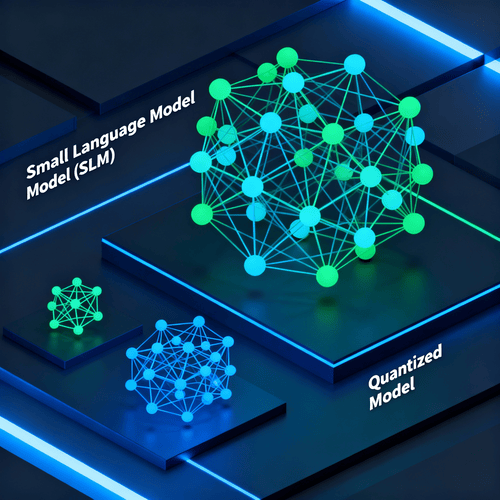
To address this challenge, the field has converged on two primary solutions: building Small Language Models (SLMs) and applying Quantization techniques. While both aim for cost-effectiveness and broader accessibility, they represent fundamentally different approaches to achieving efficiency.
SLMs vs. Quantized Models: Two Roads to Efficiency
The core difference lies in when and how the efficiency is achieved.
Small Language Models (SLMs) are inherently small, typically defined as having between 100 million and 7 billion parameters. Their small size is a result of intentional architectural design and rigorous training strategies, often involving "over-training" compared to the estimates of the Chinchilla scaling law, to deploy powerful models using more training-time compute. SLMs are engineered to be lightweight and affordable from the ground up.
Quantization is a technique that involves reducing the numerical precision (bit-width) of model parameters (weights) and/or activations, typically from full-precision (FP16 or BF16) down to low-bit formats like 8-bit (INT8) or 4-bit (INT4). This technique is typically applied after training, known as Post-Training Quantization (PTQ). A model is considered "quantized" if this compression has been applied, regardless of its original size. Extreme examples include the BitNet b1.58, where weights are ternary {−1,0,1}, resulting in just 1.58 bits per parameter.
Quantized models, therefore, are often large models (LLMs) that have been compressed (e.g., a 70B FP16 model compressed into 4-bit weights), but the technique can also be applied to SLMs to achieve further reductions in cost and memory.
Similarities: The Shared Goals of SLMs and Quantization
Despite their different origins, both SLMs and quantization methods are driven by the goal of lowering the barrier to entry for high-performance AI:
- Deployment on Resource-Constrained Devices: Both approaches significantly reduce memory footprint and computational requirements, enabling deployment on a wider range of hardware, including mobile and edge devices, where latency and memory are critical constraints. Deploying 1.58-bit LLMs, for example, has the potential to greatly improve performance on edge and mobile devices limited by memory and computational power.
- Cost and Energy Reduction: Both are critical for minimizing the environmental and economic impact associated with training and inference. Quantization improves inference speed, memory efficiency, throughput, and latency compared to full-precision baselines, while SLM benchmarks like SLM-Bench specifically measure environmental sustainability metrics such as CO2 emissions and energy usage.
- Performance Retention (Often): Both approaches strive to maintain performance comparable to larger, full-precision models, especially in ideal settings. For instance, certain SLMs, like the Phi family, achieve performance levels in reasoning tasks comparable to LLMs that are much larger. Similarly, highly effective quantization methods, like BitNet b1.58, can match the perplexity and end-task performance of full-precision LLMs starting from a 3B size.
Differences: Architectural Size vs. Precision Reduction
| Feature | Small Language Models (SLMs) | Quantized Models |
|---|---|---|
| Primary Method | Intrinsic model size reduction (fewer parameters) via optimized architecture. | Extrinsic compression (lower bit-width) of weights/activations. |
| Performance Resilience | Generally maintain robust accuracy in full precision; accuracy drop is often minimal with Int8 quantization. | Accuracy retention heavily dependent on technique (e.g., GPTQ, AWQ, SmoothQuant) and extreme bit-widths (e.g., Int4 or 3-bit) often cause significant performance degradation. |
| Scaling and Architecture | Relies on efficient components like Group-Query Attention (GQA), RMSNorm, and SwiGLU activation. | Focuses on mitigating quantization errors caused by activation outliers using techniques like rotation, scaling, or low-rank compensation. |
| Outlier Management | Training data quality is paramount to capability. | Outlier mitigation techniques (e.g., AWQ, SmoothQuant) are essential to prevent errors, especially in 4-bit quantization. |
Quantization effects can magnify a model’s existing weaknesses. When extreme quantization (e.g., 4-bit) is applied to smaller LLMs (1B scale), it often leads to severe accuracy loss, particularly in challenging areas like or instruction-following. Conversely, larger models (70B-scale) tend to maintain more stable performance even when GSM8k quantized to 4 bits.
Furthermore, extreme quantization requires nearly no multiplication operations for matrix multiplication (as seen in BitNet b1.58), enabling a new computation paradigm and specific hardware optimization.
Best Use Cases: When to Choose Size or Compression
The optimal choice often depends on the task requirements, hardware limitations, and acceptable accuracy trade-offs.
SLMs (The Specialized Workhorse)
SLMs are proving to be the future of agentic AI because they are fundamentally more economical and suited for the specialized, repetitive tasks typical of AI agents.
- Domain-Specific Accuracy: SLMs, potentially combined with light compression (like Int8), excel when tailored for specific fields where privacy or real-time performance is crucial (e.g., healthcare, law).
- Automated Program Repair (APR): Code-specific SLMs (e.g., Phi-3) with int8 quantization offer competitive bug-fixing accuracy compared to LLMs while drastically reducing resource requirements, making them viable for integration into software development environments.
- On-Device Processing: When deploying on resource-constrained devices like mobile phones or embedded systems, SLMs (100M–5B parameters) provide the best balance of capability and efficiency, handling tasks like tool calling, intent recognition, and instruction following.
- Balancing Metrics: Models like Llama-3.2-1B excel in correctness (accuracy), while Phi-1.5B is the most resource-friendly option in consumption (energy and CO2 emissions), offering clear choices based on specific priorities.
Highly Quantized Models (The Efficiency Maximizer)
Highly quantized models, whether they are compressed LLMs or intrinsically efficient designs like BitNet b1.58, are ideal when maximizing resource savings is the absolute priority, often necessary for high-volume inference.
- Maximal Memory and Latency Reduction: Aggressive quantization (like W4A4 or 1.58-bit) provides the best performance in terms of memory, throughput, and latency. This is especially true during the decode stage on mobile devices, which is typically bandwidth-bound and benefits greatly from weight compression.
- Hardware Co-design: Models leveraging novel low-bit formats like MXFP4 or FP8 are increasingly robust and advantageous when deployed on hardware specifically supporting those formats (e.g., NVIDIA H100 GPU and RTX 6000 Ada). FP8, in particular, is noted as the most robust quantization option across model sizes and tasks.
- Agentic Systems (Heterogeneous): While specialized SLMs handle most tasks, a heterogeneous system may utilize a highly quantized LLM (or a larger quantized SLM) as a generalist "safe guard" or complex conversation handler, balancing low cost with occasional access to broader knowledge.
Ultimately, for practical deployment in efficient real-world applications, SLMs combined with moderate quantization (Int8) often represent a Pareto improvement—achieving performance comparable to large models with significantly lower cost. Aggressive quantization (Int4 and lower) remains a promising research direction, especially with innovations like 1.58-bit parameters and combined PTQ methods (e.g., AWQ and GPTQ with MXINT formats) that aim to mitigate accuracy loss at restrictive bit-widths.
~Kaivalya Dixit